
What is EPR fee modulation?
Generally speaking, a producer joins a producer responsibility organisation (PRO) in order to meet its obligations. This PRO handles the prevention and management of the waste generated by the products the producer places on the market. In return, the producer pays the PRO a financial contribution referred to as an «EPR fee».
EPR fee modulation was first introduced on several EPR schemes in 2010. Its aim was to encourage producers to improve end-of-life management of their products. Since 2015, the purpose of modulation has shifted to improving the entire product life cycle.
This mechanism adjusts the EPR fees paid in line with a set of ecodesign criteria: the more a product is designed to be sustainable, repairable and recyclable, the lower the EPR fee will be.
Conversely, the more a product falls short of its target environmental performance, the higher its EPR fee will be.
The objective of modulation is to encourage producers to place more virtuous products on the market, and to discourage certain practices such as introducing components that disrupt recycling or designing products that are difficult to repair.
Which EPR schemes are concerned by modulation?
In 2025, modulation is applied in 15 EPR schemes
Some schemes have been modulating their fees for several years and have revised their modulation structures several times, as is the case in the electrical and electronic equipment scheme and the household packaging scheme. In other schemes, modulation has been introduced more recently. These include building products and home improvement & gardening goods, as of 2024.
Dates of introduction of modulation in each scheme
What are the benefits for producers?
2010
2010
What are the benefits for producers?
2011
Emballages ménagers
2011
Emballages ménagers
Textiles, linges, chaussures
2012
2012
Textiles, linges, chaussures
2013
Piles et accumulateurs
2013
Piles et accumulateurs
Papiers graphiques
2014
2014
Papiers graphiques
2018
Ameublement
2018
Ameublement
Equipements électriques et électroniques professionnels
2020
2020
Equipements électriques et électroniques professionnels
2022
Produits chimiques (cat. 3 à 10), Tabac
2022
Produits chimiques (cat. 3 à 10), Tabac
Lubrifiants, Sport et loisirs, Jouets
2023
2023
Lubrifiants, Sport et loisirs, Jouets
2024
Bâtiments, Bricolage et jardin, Dispositifs médicaux
2024
Bâtiments, Bricolage et jardin, Dispositifs médicaux
Emballages professionnels de la restauration, Pneumatiques
2025
2025
Emballages professionnels de la restauration, Pneumatiques
What are the benefits for producers?
For producers, modulation is an encouragement to incorporate ecodesign into their practices and stand out on the market. By complying with a set of exacting environmental criteria they can reduce their EPR fee while meeting consumers’ expectations and anticipating future changes to the regulations.
From bonus/malus to bonuses (incentives) and penalties: the shift to a more motivational system
Prior to 2021
Modulation was initially based on a ‘bonus/malus’ scheme introduced by the French Grenelle 2 Law in 2010. The criteria focused mainly on the end-of-life of products, including aspects such as recyclability or the absence of materials that disrupt recycling. ‘Bonus’ (lower fee) and ‘malus’ (higher fee) amounts were expressed as a percentage of the EPR fee.
Bonus
Reduces the EPR fee paid for the most virtuous products.
Malus
Increases the EPR fee for products with a greater environmental impact.
From 2021: changes with the French AGEC Law and Climate and Resilience Law
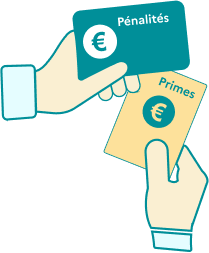
Following the AGEC Law in 2020 and then the Climate and Resilience Law in 2021, the bonus-malus scheme was replaced with bonuses and penalties, to provide greater financial motivation. These criteria focus on the entire product life cycle and include aspects such as reparability, sustainability, use of renewable resources, and more.
Bonuses
May reduce the EPR fee paid or even cancel it out for the most virtuous products.
Penalties
May exceed the initial EPR fee amount in order to encourage a producer to substantially improve its practices.
Modulation and EU law
The principle of EPR fee modulation is also enshrined in EU law, having been introduced by the Directive of 30 May 2018 on waste. Each Member State is responsible for its application in concrete terms.
Some EU regulations specific to a given scheme may also influence the modulation structure within that scheme, with a view to harmonising practices within the EU market to some degree. This is the aim of the Batteries Regulation published in 2023, and the 2025 Packaging Regulation.
How is modulation set up within a scheme?
The French Anti-Waste Act for a Circular Economy (‘AGEC Law’) sets a common framework for all EPR schemes granted accreditation as of 1 January 2021. Each set of accreditation specifications lays down the modulation criteria to be used. In some cases this is a simple list of criteria, while in others the conditions and amounts are clearly defined.
Each PRO uses these criteria as the basis for designing its own modulation system. This proposal is discussed within its stakeholder committee before being sent to the State for approval.
Special cases
- When several PROs operate within a given scheme, they may work together on one or several stages of the process under the supervision of the scheme’s coordination body, if it has one.
- In some cases, the State itself may decide to lay down the modulation rules by ministerial order. In this case, all the PROs within the scheme apply the same modulations.
N.B : modulation does not apply to individual compliance schemes.
Review of the criteria and amounts in force in 2023
Details of the criteria and the amounts of bonuses and penalties in force in 2023
See the overview of modulation systems