


Ecodesign

Sustainability

Valuation
What is Extended Producer Responsibility (EPR)?
Extended Producer Responsibility, or EPR, is a principle under which companies that place products on the market are responsible for their environmental impact throughout their lifespan, from design to end-of-life.
In practical terms, it means that producers must finance and organise the collection, sorting, reuse and recycling of their products. This is the application of the ‘polluter pays’ principle: those who put products on the market are responsible for managing the environmental consequences associated with them once they become waste.
But EPR does not stop when products reach the end of their lifespan.
Right from the design stage, producers are encouraged to create products that are more sustainable, repairable and recyclable, in order to reduce the quantities and environmental impacts of waste.
This approach hence encourages reuse, repairing and recycling, driving a circular economy.
Producer responsibility organisations: bearing responsibility in exchange for a financial contribution
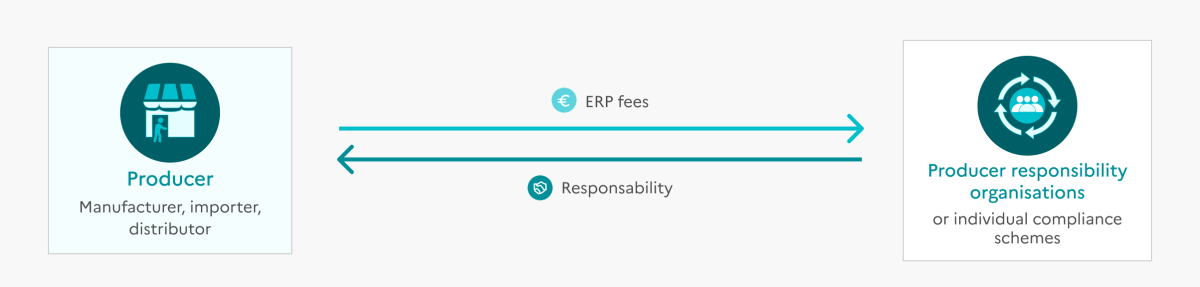
In most cases, a producer will join a producer responsibility organisation (PRO) in order to meet its regulatory obligations. This organisation will take on the producer’s responsibility in exchange for a financial contribution referred to as an ‘EPR fee’.
The amount of the EPR fee paid by the producer may vary depending on the environmental impact of its product. The regulations provide for a system of bonuses and penalties in a number of schemes in order to modulate (adjust) the amounts paid in line with the efforts made. Some PROs also propose their own modulations. The amount of the EPR fee is set by each PRO.
Find out more about EPR fee modulation
What is an EPR scheme?
A scheme – also sometimes referred to as a sector – is a family of everyday products used by households and/or professionals. They are defined by Article L541-10-1 of the Environmental Code.
The first national, regulated EPR scheme was set up for household packaging collection in 1992. Similar systems were then introduced for other products such as batteries, les electrical and electronic equipment, papers and apparel.
What are the schemes?
Today there are 19 EPR schemes.
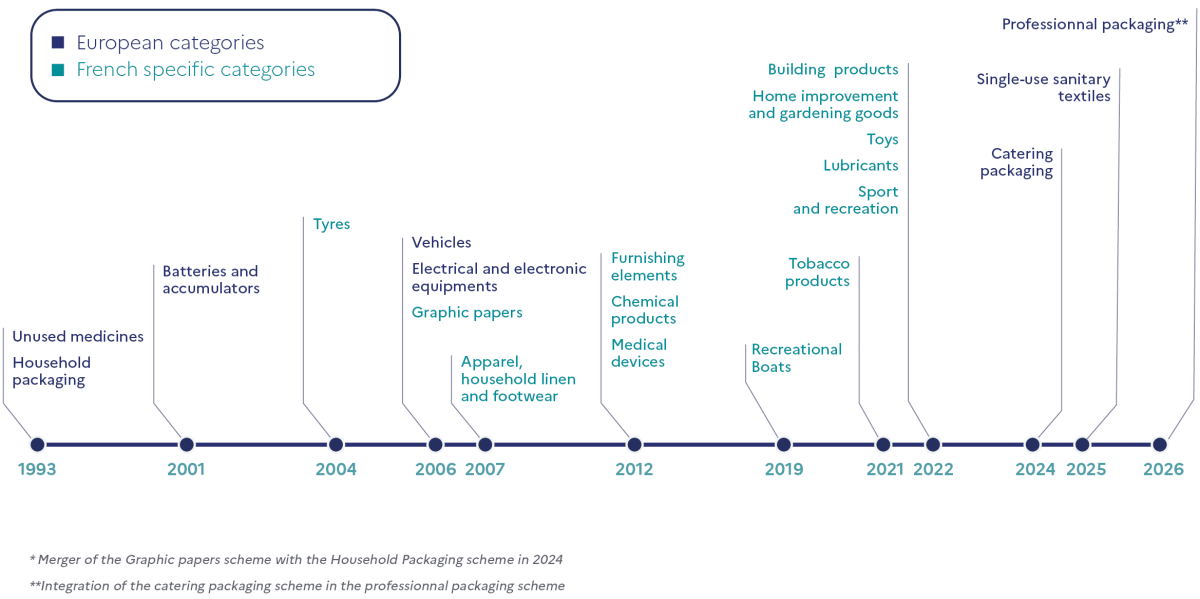
1993: Unused medicines, Household packaging. 2001: Batteries and accumulators. 2006: Vehicles, Electrical and electronic equipments. 2024: Catering packaging (soon integration in the professionnal packaging scheme).2025: Single-use sanitary textiles. 2026: Professionnal packaging* French specific categories: 2004: Tyres. 2006: Graphic papers (erger with the Household Packaging scheme in 2024). 2007: Apparel, household linen and footwear. 2012: Furnishing éléments, Chemical products,Medical devices. 2019: Recreational Boats. 2021: Tobacco products. 2022: Building products, Home improvement and gardening goods, Toys, Lubricants, Sport and recreation.
What is the procedure for setting up a scheme?
An EPR scheme is set up according to a structured process involving the public authorities (Ministry for the Ecological Transition, Ministry of Industry and Finance and ADEME), the producers, and the PROs applying for accreditation.
Are you a producer?
Find out how you can meet your obligations in just a few steps.
Find out about my obligations