

Producer responsibility organisations
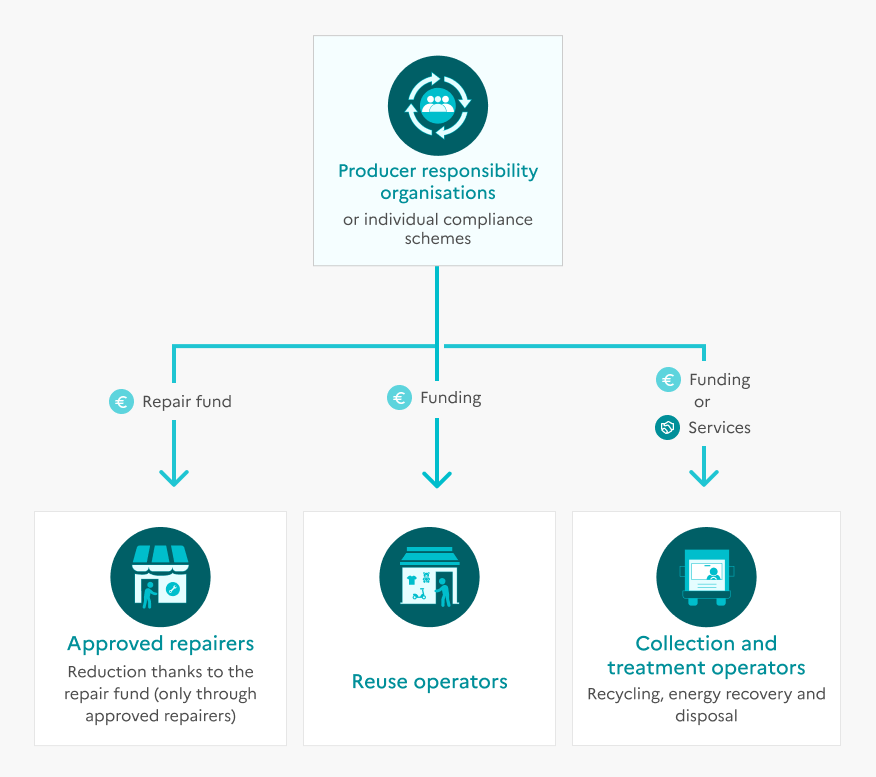
When producers decide to group together and form a producer responsibility organisation (PRO), this organisation takes on their responsibilities on their behalf. For each product placed on the market, the producer pays an EPR fee to the PRO it has joined. The fee amount is directly related to the type of product placed on the market and, to a large extent, the cost of end-of-life waste management.
The EPR fees hence finance all the producers’ obligations (studies, communication, awareness-raising, prevention, reuse, collection, sorting, waste recycling/recovery, etc.). The fees may be modulated through bonuses if the products meet certain environmental criteria intended in particular to encourage more sustainable design. Producers may, for example, be encouraged to extend the lifespan of their products or make it easier to recover the waste derived from them. EPR fee modulation may also result in penalties being applied to certain products if they contain hazardous substances or components that disrupt recycling, for instance.
Find out how producer responsibility organisations operate
Individual compliance schemes
If a producer decides to meet its obligations for itself, by setting up an individual collection and treatment system, it must:
- Take back all its products once they become waste, free of charge, anywhere across the country;
- Meet objectives identical to those imposed on the PROs.
Its products are hence required to bear marking identifying their origin, in order to guarantee that the collection system it puts in place will run efficiently. It must also provide a financial guarantee to cover any failings in its individual scheme.
Coordination bodies
If several PROs are accredited for the same product categories within a given EPR scheme, they must set up coordination bodies which are also subject to State accreditation. These bodies can implement collective initiatives to improve their efficiency and help to balance the different PROs.
How do you become a PRO or set up an accredited individual scheme?
To obtain accreditation from the public authorities and meet the obligations of EPR schemes, PROs and individual compliance schemes must submit an application file. As a minimum this file must address, point by point, the obligations set out in the accreditation specifications for the EPR scheme concerned. In particular it must contain targets for ecodesign, collection, recycling/recovery, and, where applicable, reuse and repair.
Once the application has been examined and approved by the State departments, accreditation is issued for a period of up to six years.
Are you a producer who has yet to comply with the EPR schemes? You need to choose between a PRO and an individual compliance scheme
Further reading
Producer responsibility organisations and individual compliance schemes: understanding them and making your choice
Find out about the differences between producer responsibility organisations and individual compliance schemes, their benefits, the obligations to be met, and how to go about choosing the solution best suited to your company.

How does a producer responsibility organisation operate?
Financial management, operational management, or a combination of both: find out about the role played by producer responsibility organisations in EPR scheme management and their impacts for product and waste management.

Which producers are concerned by EPR schemes?
What is a producer within the meaning of EPR? Find out about the key principles underpinning this definition, and which EPR schemes apply to you