
Who is considered a producer?
Article L.541-10 of the French Environmental Code defines a producer as any natural person or legal entity that, in a professional capacity, places a product on the French market for the first time, whether it is intended for households or professionals.
Depending on the circumstances, this may be:
- The manufacturer, when it designs and manufactures a product in France;
- The importer, when it introduces a product manufactured abroad on the French market;
- The distributor or ordering party, when it markets a product under its own brand. Marketplaces and online sales platforms are responsible for meeting the EPR obligations of products sold by third-party sellers. This requirement only applies if the third party has not already fulfilled its obligations.
The key principle is placing a product on the market for the first time in France.
The products concerned
As a producer, you must meet the EPR obligations applicable to your products falling under one or more EPR schemes.
To find out whether a product falls under an EPR scheme, consult the page dedicated to each one on our website.
A given product may come under several EPR schemes. For example, a mobile phone may fall under the Electrical and electronic equipment scheme, the Batteries scheme, and also the Household packaging scheme.
N.B.: even if your product does not come under a specific scheme, you are likely concerned by the household packaging scheme.
This scheme applies to you as soon as you place packaged products for household use on the market.
Specific cases in various schemes
The definition of producer and the scope of products concerned may include rules or provisions specific to a given EPR scheme.
View the details for each schemeWhat obligations must a producer meet?
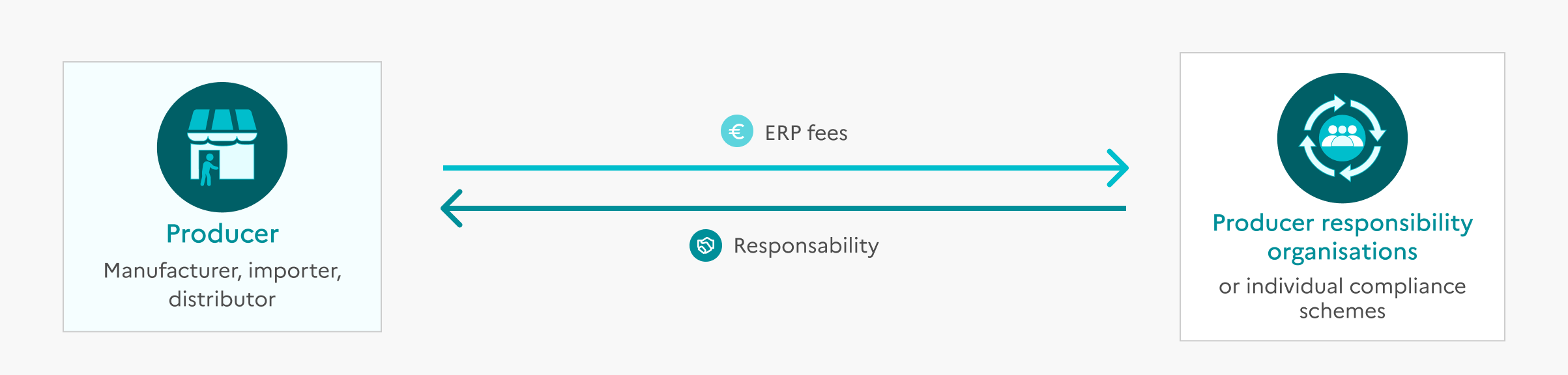
Article L.541-10-1 of the Environmental Code requires the producer to take responsibility for the environmental impact of its products. The producer can choose between two solutions:
- Joining an accredited producer responsibility organisation (PRO): a non-profit collective organisation that takes on these obligations in return for an EPR fee.
- Setting up an accredited individual compliance scheme: handle the collection and treatment itself of the waste generated by its products (under its own brand(s)).
The case of distributors
Retailers and wholesalers alike are required to inform their customers about end-of-life product management. In some EPR schemes, they may be required to take such products back free of charge, with or without a purchase obligation. In some cases, retail floor space or turnover is taken into account in applying this take-back obligation.
Pour aller plus loin
The role of producer responsibility organisations and individual compliance schemes in EPR schemes
Understand the role of producer responsibility organisations and individual compliance schemes in EPR schemes, and how to meet your obligations under the regulations
The role of consumers in EPR schemes
Individuals and professionals: find out about the role of consumers in EPR schemes and how to adopt sustainable habits, repair and sort your products.
The role of reuse, repair, collection and treatment operators in EPR schemes
Find out about the key role played by reuse, repair, collection and treatment operators and local authorities within EPR schemes